Water Chemistry
Reading Your Water Test Results
A test kit is only useful if you know what the numbers mean. Here is a plain-language guide to the parameters that matter most.
Dr. Priya Nair
February 3, 2026·8 min read
The nitrogen cycle is the single most important concept in fishkeeping. Get it wrong and your fish suffer. Get it right and everything else becomes manageable.
Dr. Priya Nair
Dr. Priya Nair holds a PhD in aquatic biology and has kept freshwater and marine aquariums for over 20 years. She writes about water chemistry and fish health.
The nitrogen cycle is the single most important concept in fishkeeping. It is the biological process by which toxic ammonia — produced by fish waste, uneaten food, and decaying plant matter — is converted by beneficial bacteria into progressively less harmful compounds. Get it wrong and your fish suffer. Get it right and everything else becomes manageable.
Here is how it works. Fish excrete ammonia (NH₃) directly through their gills and in their waste. Even small amounts of ammonia are toxic to fish, damaging gill tissue and suppressing the immune system. In a properly cycled aquarium, a colony of Nitrosomonas bacteria colonizes your filter media and converts ammonia into nitrite (NO₂⁻). Nitrite is also toxic — it interferes with the blood's ability to carry oxygen. A second bacterial colony, Nitrospira, then converts nitrite into nitrate (NO₃⁻), which is relatively harmless at low concentrations and is removed through regular water changes.
A new aquarium has no beneficial bacteria. You must establish these colonies before adding fish, or do so very carefully with a fish-in cycle. The fishless cycle is preferable: add an ammonia source (pure ammonia drops, fish food, or a raw shrimp) and wait. Test your water every two to three days. You will see ammonia spike first, then nitrite, then both will drop as the bacterial colonies establish. When you can add a dose of ammonia and see it converted to zero within 24 hours, your tank is cycled.
This process typically takes four to six weeks at room temperature. It can be accelerated by seeding your filter with media from an established tank, using a bottled bacteria product, or raising the temperature slightly (to around 80°F / 27°C).
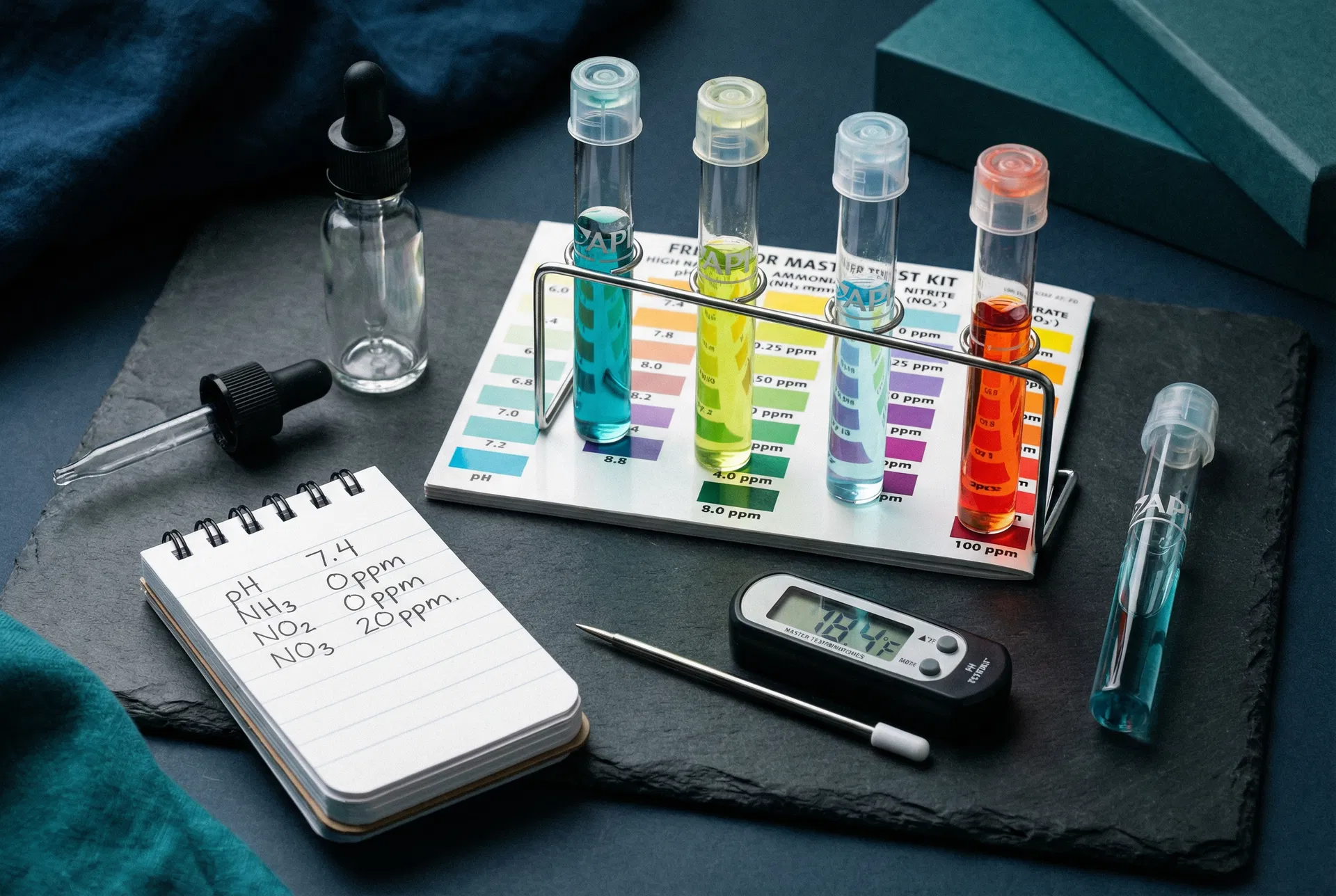
During the cycle, you need a liquid test kit — not test strips, which are notoriously inaccurate. The API Master Test Kit covers pH, ammonia, nitrite, and nitrate and is the standard recommendation for freshwater tanks. Test every two to three days and log your results. Watching the numbers change over time is genuinely satisfying and teaches you how your specific tank behaves.
A cycled tank is not a maintenance-free tank. The bacterial colony is sized to handle the current bioload. Add too many fish at once and you can overwhelm the cycle, causing a "mini-cycle" with elevated ammonia and nitrite. Add fish gradually, test regularly for the first few weeks after each addition, and perform water changes if parameters spike.
The nitrogen cycle is not complicated once you understand it. It is biology doing exactly what biology does — finding a way to process waste. Your job is to give it the conditions to do so.
Track your water parameters with MudCap AquaJournal
Log pH, ammonia, nitrite, nitrate and more — then get AI insights when something looks off.
Start free at mudcapjournal.com →A test kit is only useful if you know what the numbers mean. Here is a plain-language guide to the parameters that matter most.